 SkillBamboo
A Short that takes off is usually not lucky. Its YouTube Shorts script was put together on purpose, one step at a time.
If you’ve posted a Short that stopped at a few hundred views while other creators’ clips took off, you probably couldn’t tell what went wrong: the idea, the opening or the edit.
Below is one Shorts creator’s method, step by step, from the idea list to the last second you cut. By the end you’ll have a skeleton for your next Short (hook, foreshadow, final line and mechanism) and know which two numbers in YouTube Studio show what to fix once it’s live.
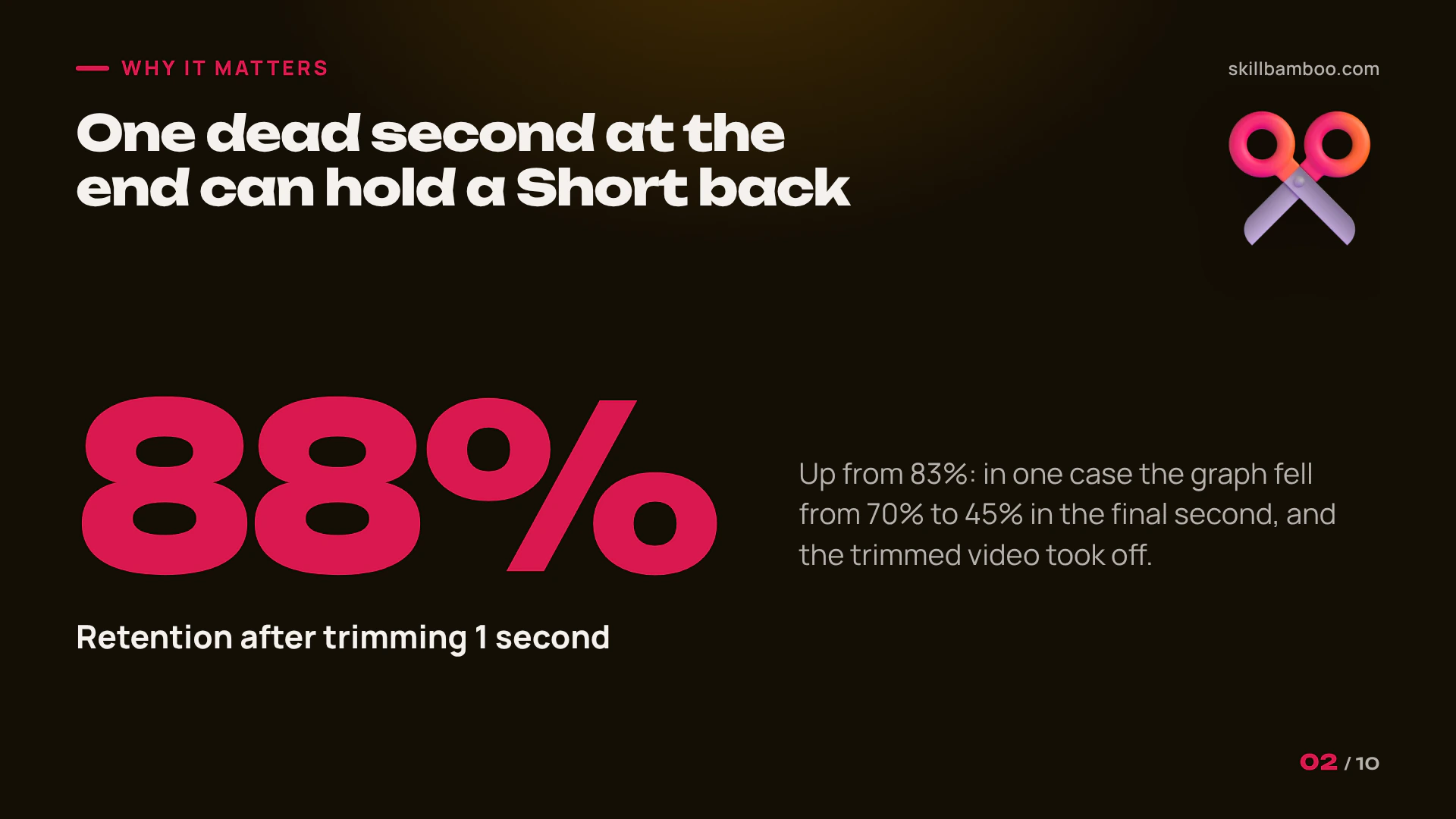
The good news is that the fix is sometimes tiny. In one case, cutting a single dead second at the end lifted retention to 88%, up from 83%, and the video took off.
Choose ideas you want to make, then filter them
In the year to October 2023, Jenny Hoyos pulled in more than 600 million Shorts views – an average of about 10 million per video.
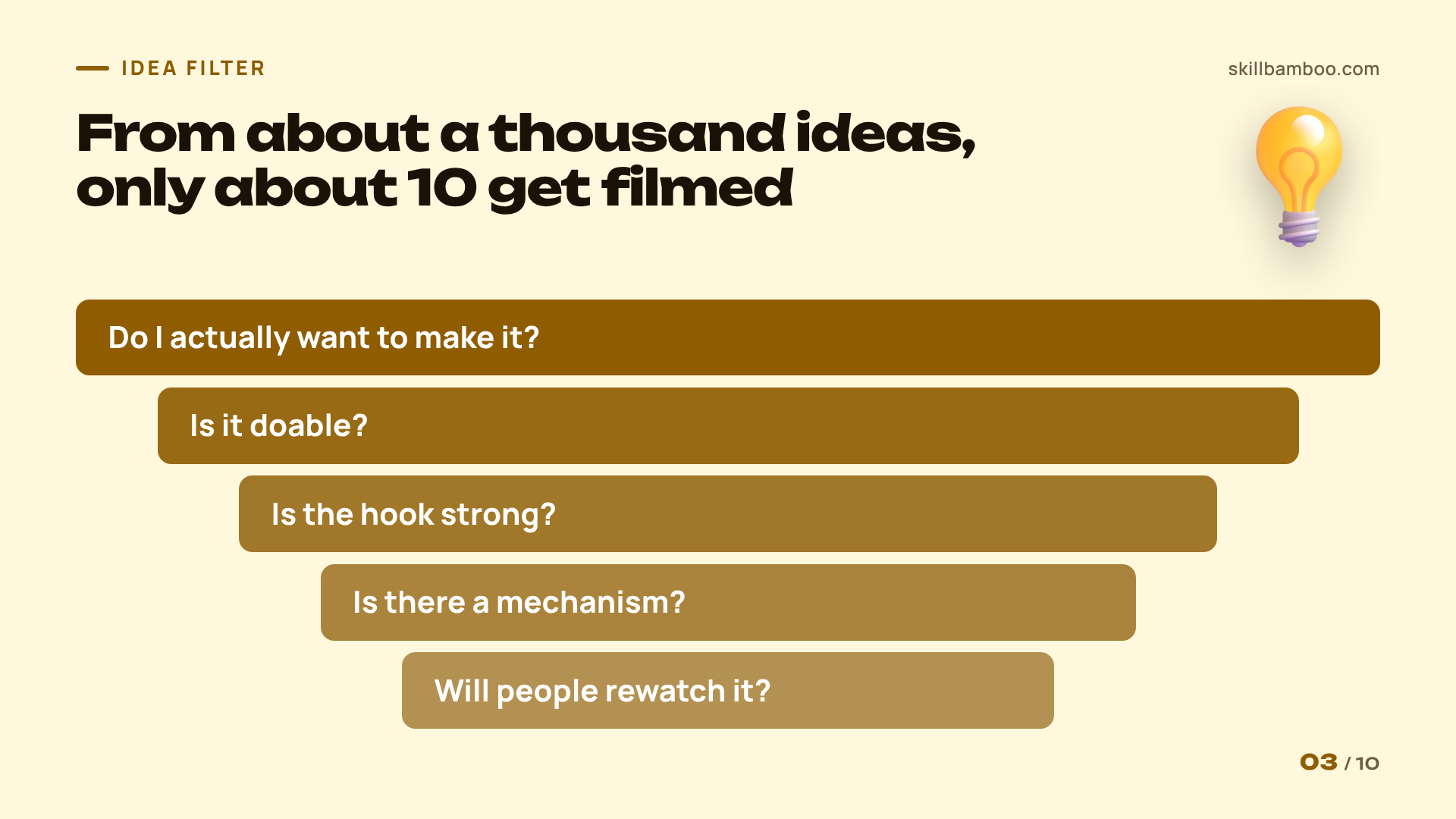
Her process starts with a question that sounds almost too simple. Before asking whether an idea could go viral, she asks whether she actually wants to make it. In her view, virality is something you can engineer once you have an idea you care about.
She keeps around a thousand ideas in a Google Doc and turns only about 10 of them into videos. Here are the four more questions an idea has to clear after the “do I want this” test:
- Is it doable? Can you actually film it with the time, money and access you have?
- Is the hook strong? More on how to test that below.
- Is there a mechanism? Something has to pull the viewer to the end.
- Will people rewatch it? A Short worth seeing twice beats one that’s merely fine.
Think of the mechanism as the reason to stay until the payoff.
Picture a challenge where a circle keeps closing in until one person is left. The shrinking circle is what keeps you watching – without it, you’d just jump to the result.
But you don’t need a big production for this. The easiest version is announcing that there are three steps, or three things you need to do. Viewers can track the progress and always know how close they are to the payoff.
Design the YouTube Shorts hook as a first frame, then write it simply
In the Shorts feed, nobody clicks a thumbnail. The video just starts, and the viewer decides in an instant: stay or swipe.
YouTube Studio measures exactly that decision as “how many chose to view”: out of all the times your Short showed up in the feed, the percentage when people didn’t swipe past. Your hook is what moves that number.
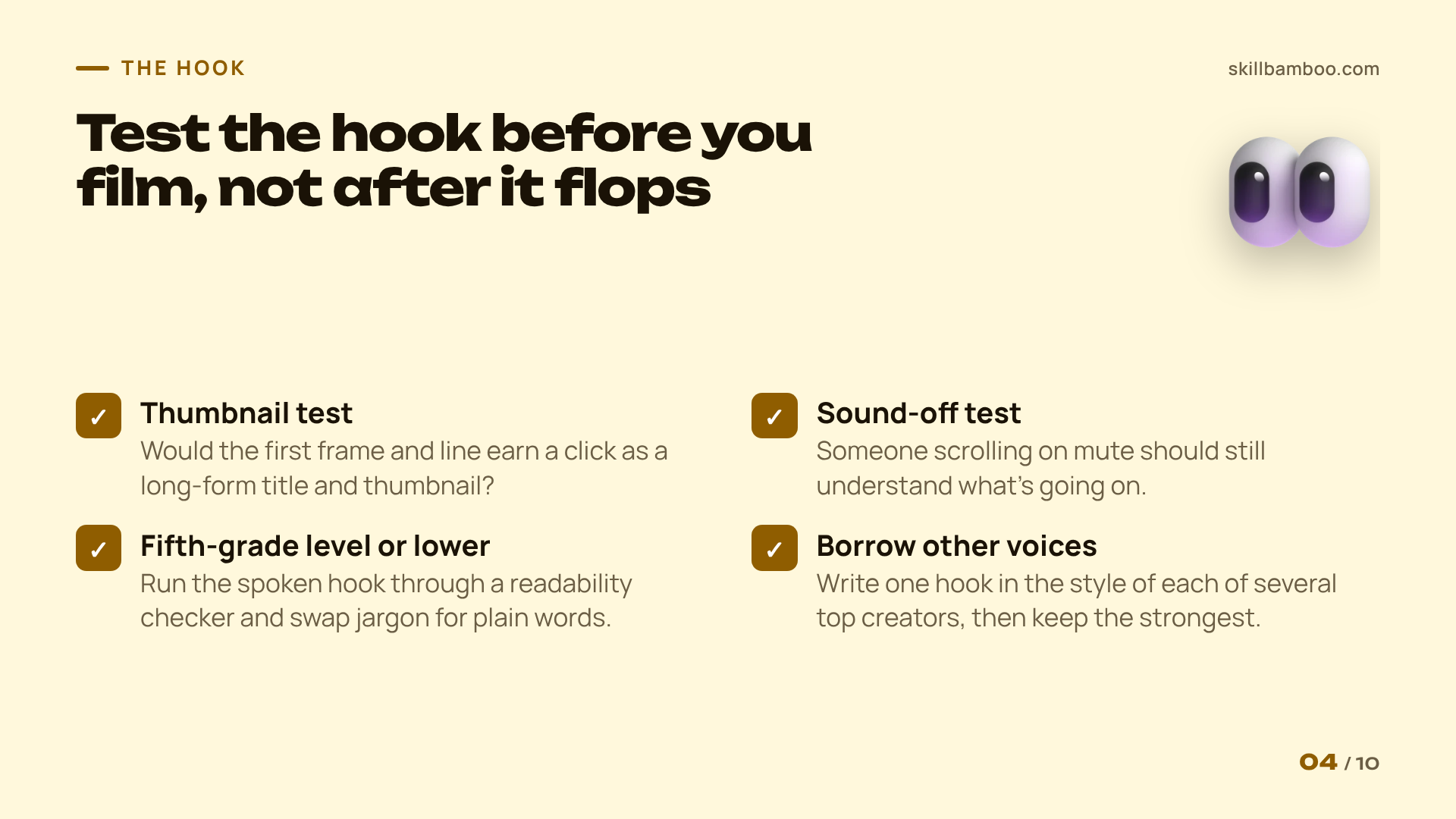
Two tests are worth running before you film anything:
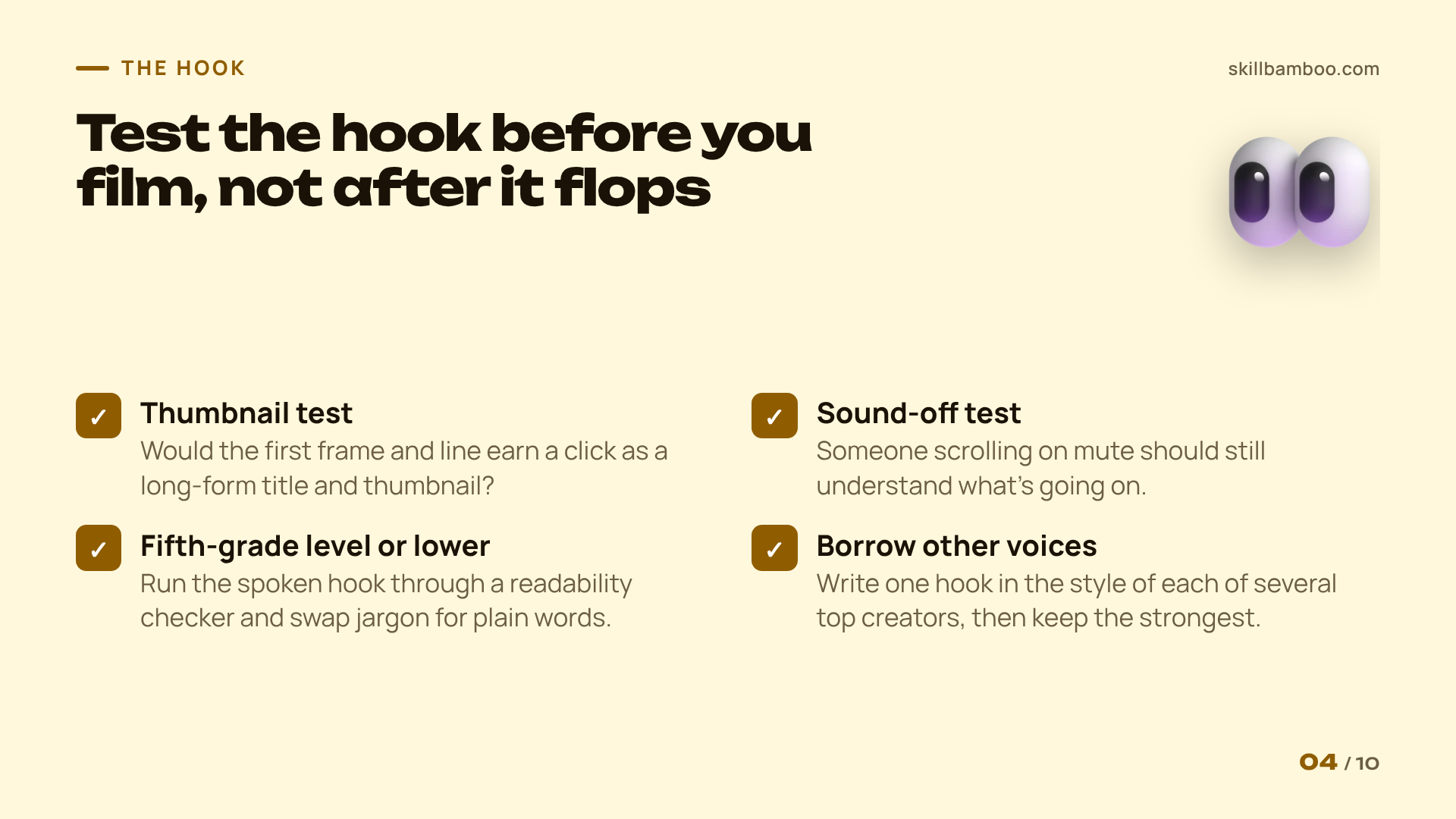
- The thumbnail test. Imagine your opening frame and line as the title and thumbnail of a long-form video. Would it earn the click? If yes, it can work as a Short hook.
- The sound-off test. The hook has to be visual. Someone scrolling with the sound off should still understand what’s going on, so the idea has to be very simple.
Watch your first frame on mute
If the opening only makes sense once you hear the voiceover, rework the visual before you touch the script.
Then write the spoken part of the hook and cut it down as far as it will go. Run it through any readability checker and aim for a fifth-grade reading level or lower.
Jargon pushes the level up fast. So swap specialist words for plain explanations, because a simple line is understood in the second the viewer gives you.
If you tend to settle for your first draft, borrow other creators’ voices instead. Pick several top creators and ask how each of them would open this exact video. Write one hook in each style, compare them and keep the strongest.
Write the script skeleton: hook, foreshadow, last line
The order in which you write matters as much as the words.
Write the hook first, then jump straight to the last line. That way you know the ending before you press record, and everything you film can head toward it.
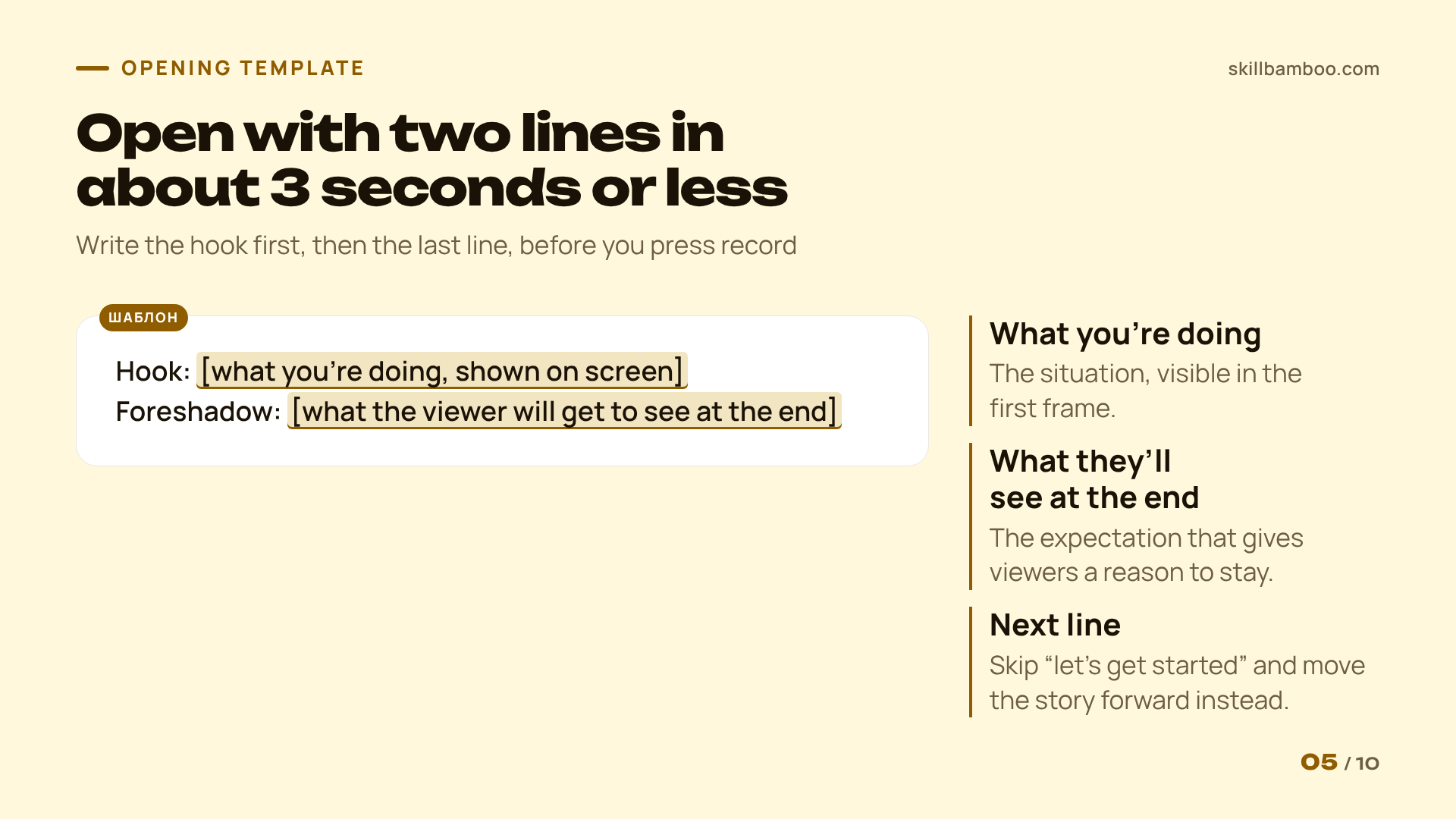
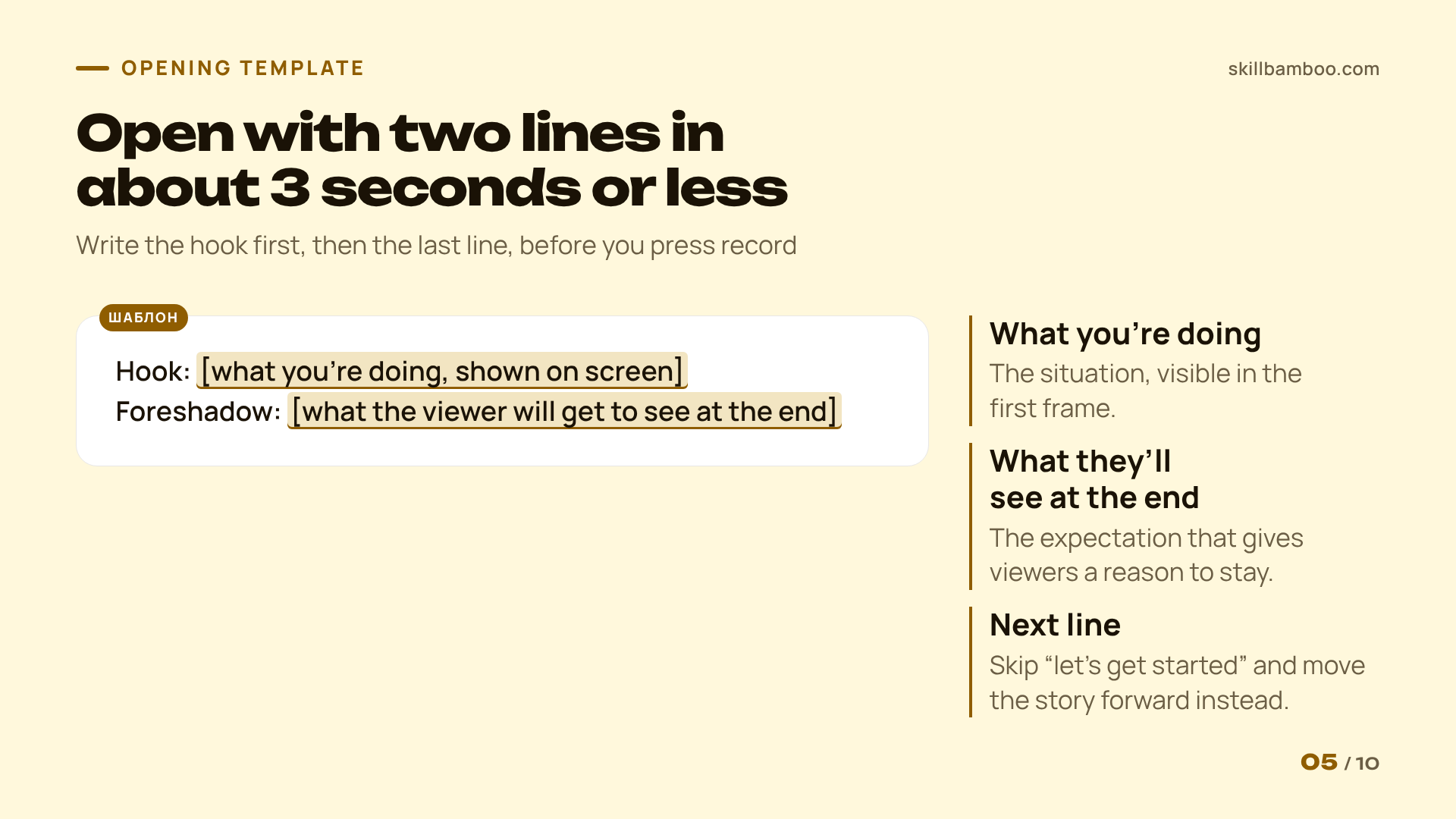
Next comes the opening. Every video starts with two spoken lines: the hook, and a foreshadow that tells the viewer what they’ll see at the end. Together they take about 3 seconds or less. Here’s the template:
- Hook: [what you’re doing, shown on screen]
- Foreshadow: [what the viewer will get to see at the end]
The foreshadow sets an expectation. And an expectation is a reason to stay.
Right after those two lines, it’s easy to break the pace. A filler line like “let’s get started” makes the video stall just when the viewer has two key details to remember.
So replace it with a line that already moves the story forward. The listener gets a breather without the pace actually dropping.
What goes between the opening and the last line can be a rough script or just bullet points to cover while filming. The fixed parts are the hook, the foreshadow and the ending.
Fill the middle with “but” and “therefore,” end with a twist
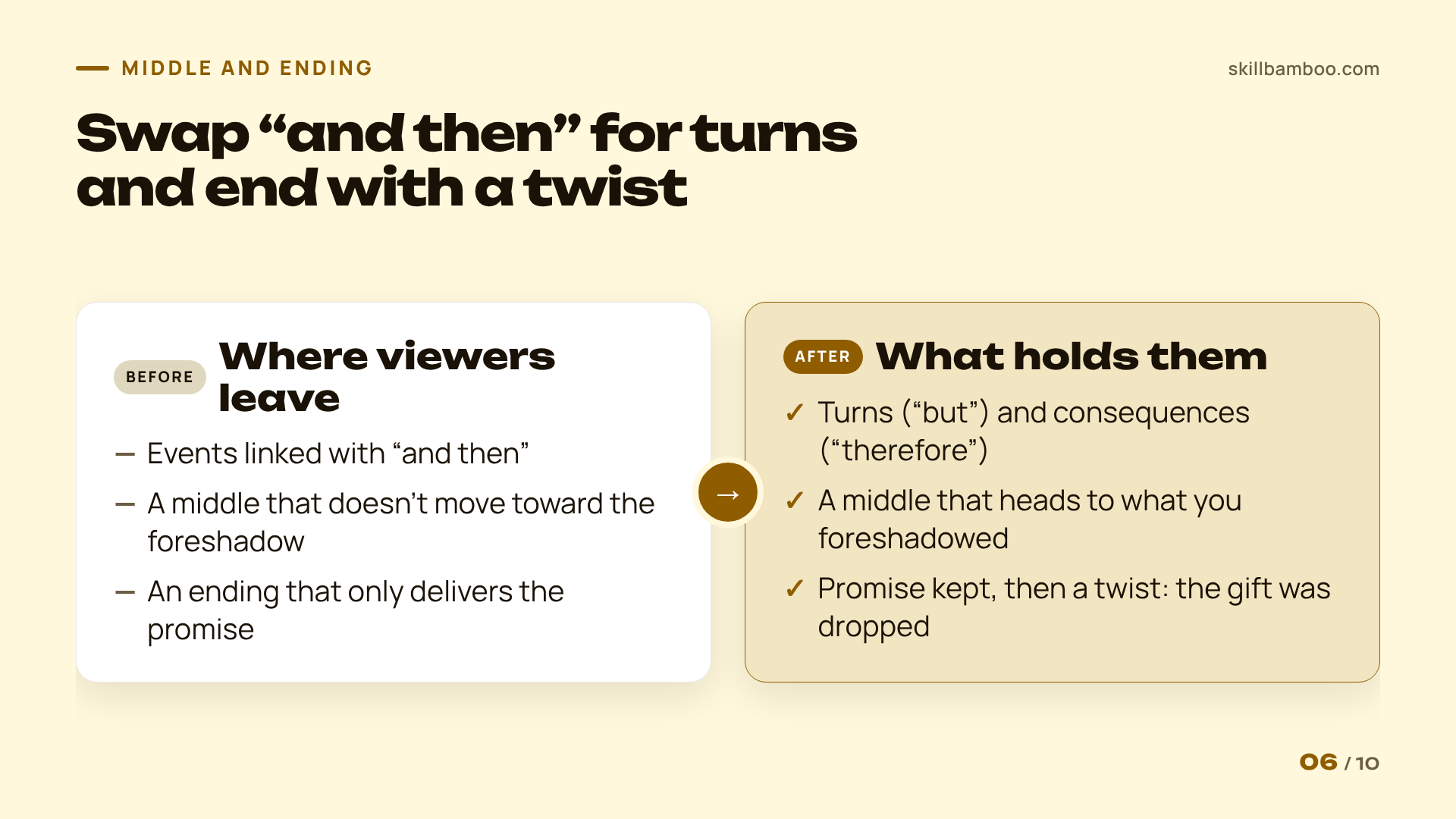
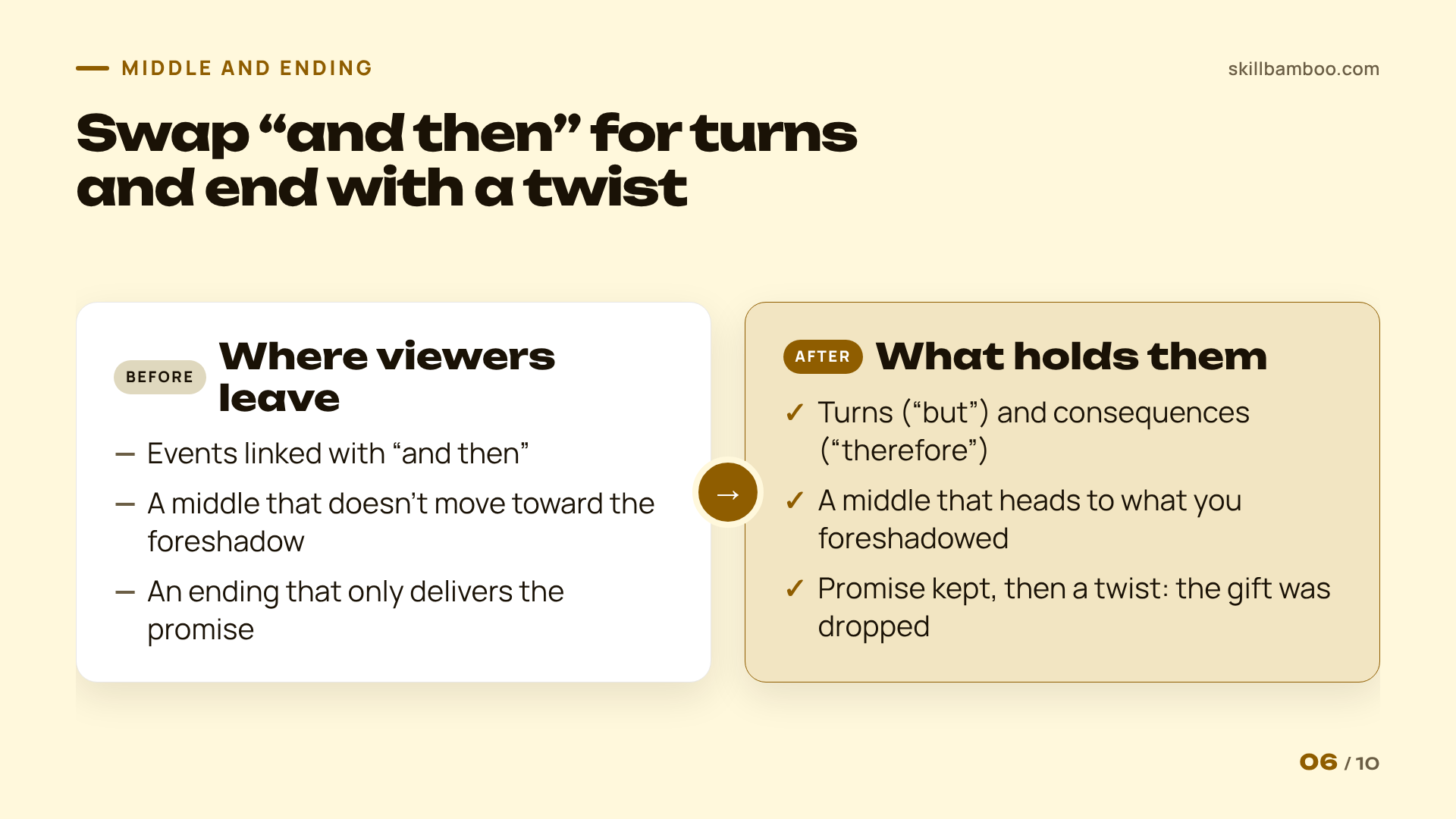
A middle where one thing simply follows another is where viewers leave.
The fix is “but/therefore” storytelling: link each event to the next with a turn (“but”) or a consequence (“therefore”) instead of “and then.” A story needs change, and these two words force it into every beat.
Your retention graph will show if the middle isn’t working. A drop partway through usually means you made a promise in the opening that the middle didn’t pay off. Look at what you foreshadowed and check that the middle actually moves toward it.
The ending has two jobs: deliver what you promised, then add something the viewer didn’t expect.
In one gift video, the promise was a surprise present. The gift was given as foreshadowed – then the recipient dropped it and it broke, and her reaction became the punchline.
The expectation is kept, and the twist makes it worth rewatching. That brings you back to the fourth question from the idea filter.
Pick your YouTube Shorts length and cut every dead second
There is no universal ideal length. It depends on your own analytics.
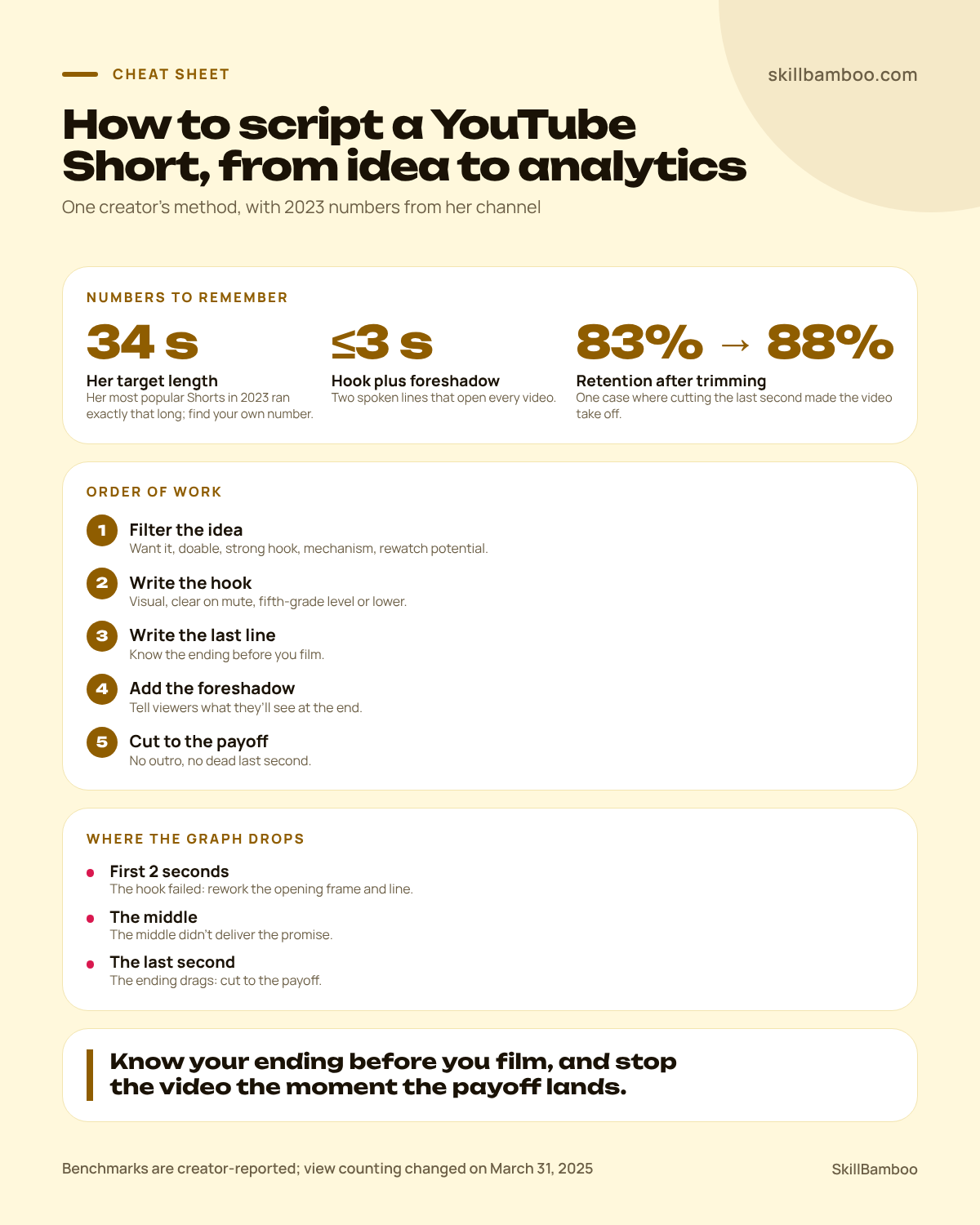
Hoyos settled on 34 seconds in 2023 because her most popular Shorts ran exactly that long. She also saw that on her channel, a Short under 30 seconds needed more than 100% retention to take off, so slightly longer worked better for her. Look at your own top videos and find your number.
Whatever the length, every second has to be worth keeping – the last one most of all.
One of her Shorts was underperforming. Its retention graph showed a fall from 70% to 45% in the final 1 second, a 25-point drop, with overall retention at 83%. Trimming that one second lifted retention to 88%, and the video took off.
End on the payoff
Whatever you promised in the foreshadow, end the video the moment it happens. No outro, no extra beat, no lingering reaction shot. Check the last second of the graph on every Short you publish.
The math explains why: in a short video, one second is a noticeable share of the total, so a dead second at the end drags down the whole average.
Read the numbers: viewed vs. swiped away, retention, loops
Once the Short is live, two metrics tell you most of the story: how many viewers chose to stay, and how much of the video they watched on average. Here’s how to read them:
| Metric | What it tells you | Reference points |
|---|---|---|
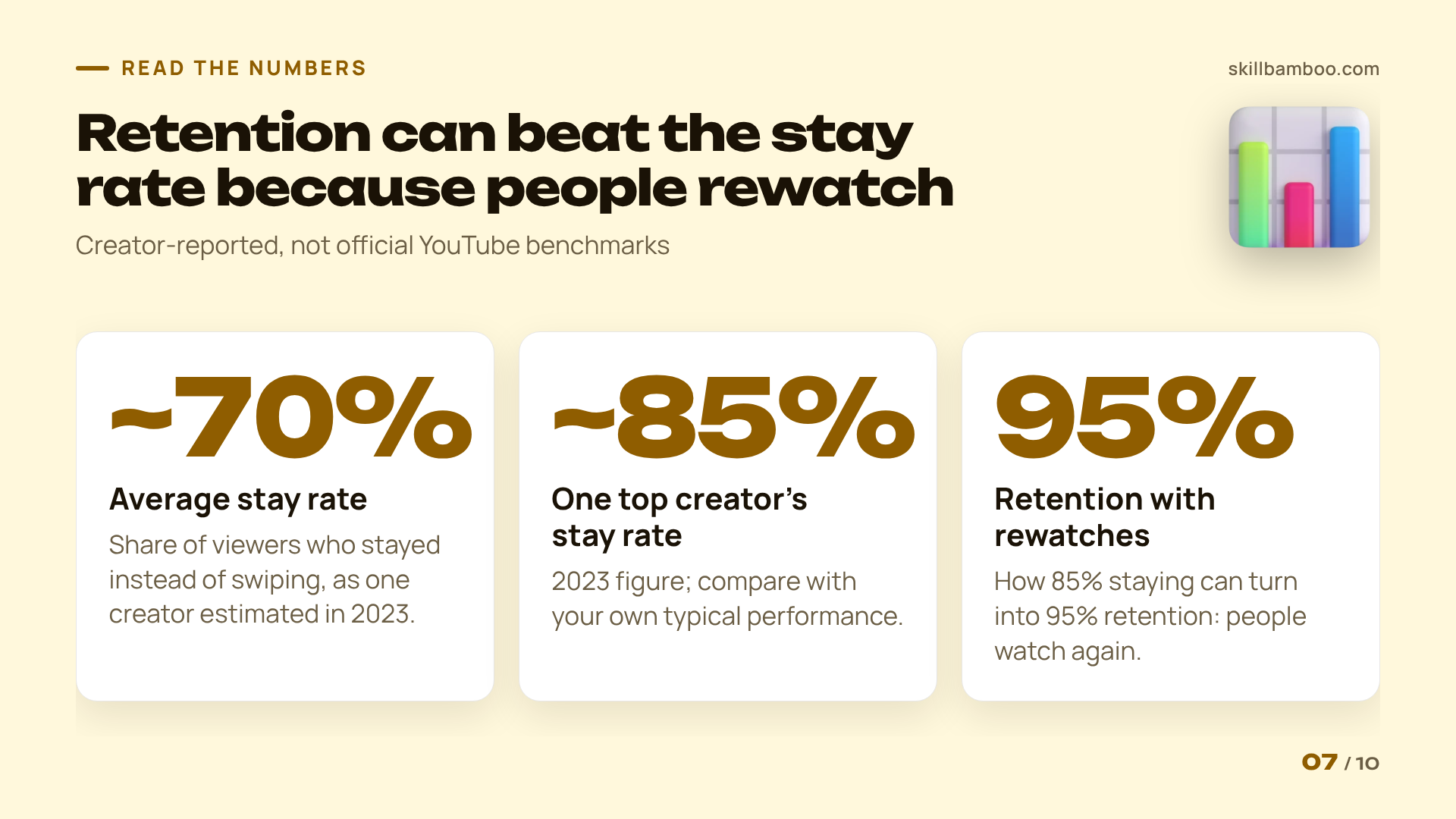
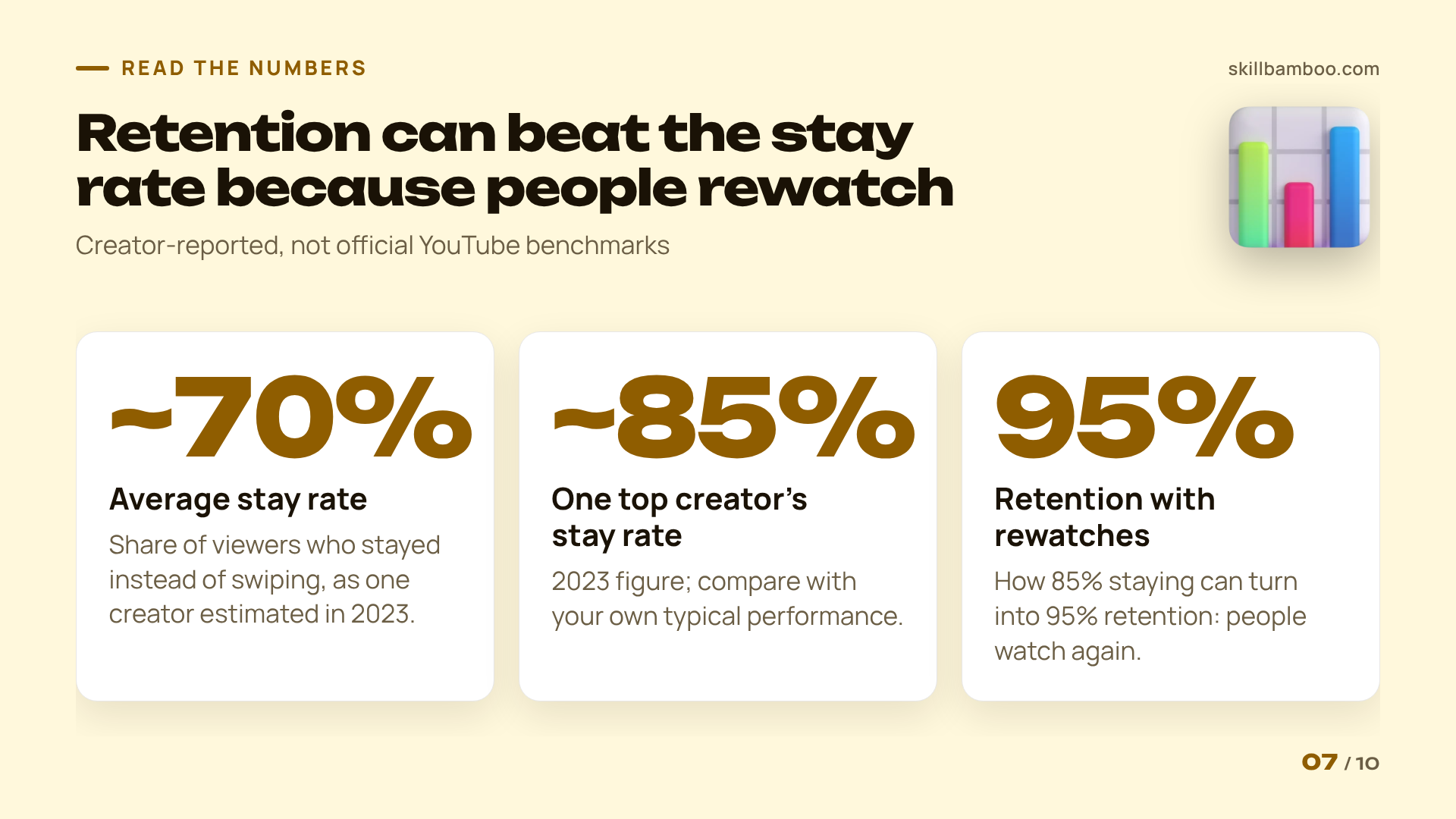
| Stayed vs. swiped away | Whether the hook worked | Around 70% on average; about 85% for one top creator (2023) |
| Average percentage viewed | Whether the middle and the ending held | Can pass 100% when viewers loop |
| Drop in the first 2 seconds | The hook failed | Rework the opening frame and line |
| Drop in the middle | The middle didn’t deliver the promise | Recheck the foreshadow and the turns |
| Drop in the last second | The ending drags | Cut to the payoff |
YouTube Shorts retention can be higher than the share of people who stayed, because people rewatch. If 85% of viewers stay and retention reaches 95%, the gap is people watching again. Loops count among the best signals your Short can give the algorithm.
But keep these numbers in perspective. YouTube publishes no official benchmarks for any Shorts metric, so every target you see, including the ones in the table, comes from creators. Your own typical performance is the more honest baseline.
And not every strong creator treats retention as the main signal. Hoyos once had a Short with only about 70% retention over its first 100K views, which is weak for Shorts, and she still thinks retention matters less than people assume.
What has changed since this playbook was built
The method above comes from 2023. The way YouTube counts Shorts has changed since then.
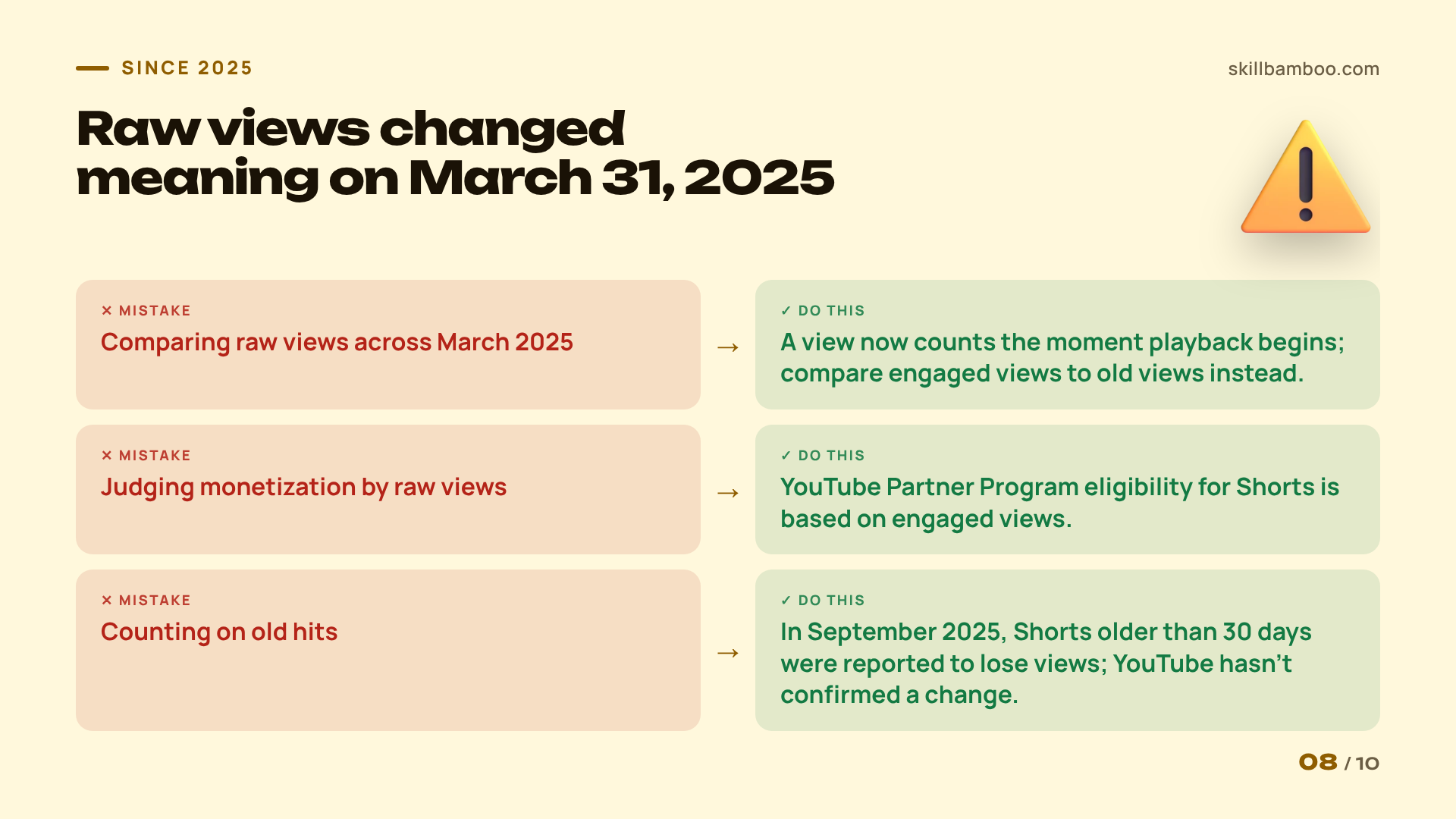
From March 31, 2025, YouTube registers a view on a Short the moment playback begins, without any minimum watch time. In other words, raw views now measure exposure more than attention.
The stricter count is called engaged views, and that’s what YouTube Partner Program eligibility for Shorts is based on.
Don’t compare old and new view counts directly
If you compare your Shorts from before and after March 2025, compare engaged views to old views. Otherwise a jump in numbers can look like growth when nothing changed.
There’s also a sign that freshness counts for more than it did.
In September 2025, Mario Joos, a retention strategist who works with MrBeast and the Stokes Twins, and other channel operators reported that Shorts older than 30 days saw abrupt view declines while newer uploads were unaffected. YouTube hasn’t confirmed a change. Still, it’s a reason not to rely on old hits to keep bringing in views.
The production method itself (hook, foreshadow, mechanism, twist, tight ending) doesn’t depend on how views are counted.
Key terms
- Foreshadow – A short spoken line right after the hook that tells viewers what will happen at the end, so they have a reason to keep watching.
- Mechanism – A built-in device, such as a countdown or a numbered list of steps, that makes viewers want to see the Short through to the end.
- Viewed vs. swiped away – The share of times a Short appeared in the feed where the viewer stayed instead of swiping past, shown in Studio as “how many chose to view.”
- Engaged views – YouTube’s stricter Shorts view count, used for Partner Program eligibility, as opposed to raw views counted on any play.
- “But/therefore” storytelling – A way to structure a story in which each event is linked to the next by a turn (“but”) or a consequence (“therefore”) instead of “and then.”
- Readability grade level – An estimate of the school grade needed to understand a text, used to keep scripts simple.
Summary: your Shorts checklist
Use this list for your next Short, from idea to analytics:
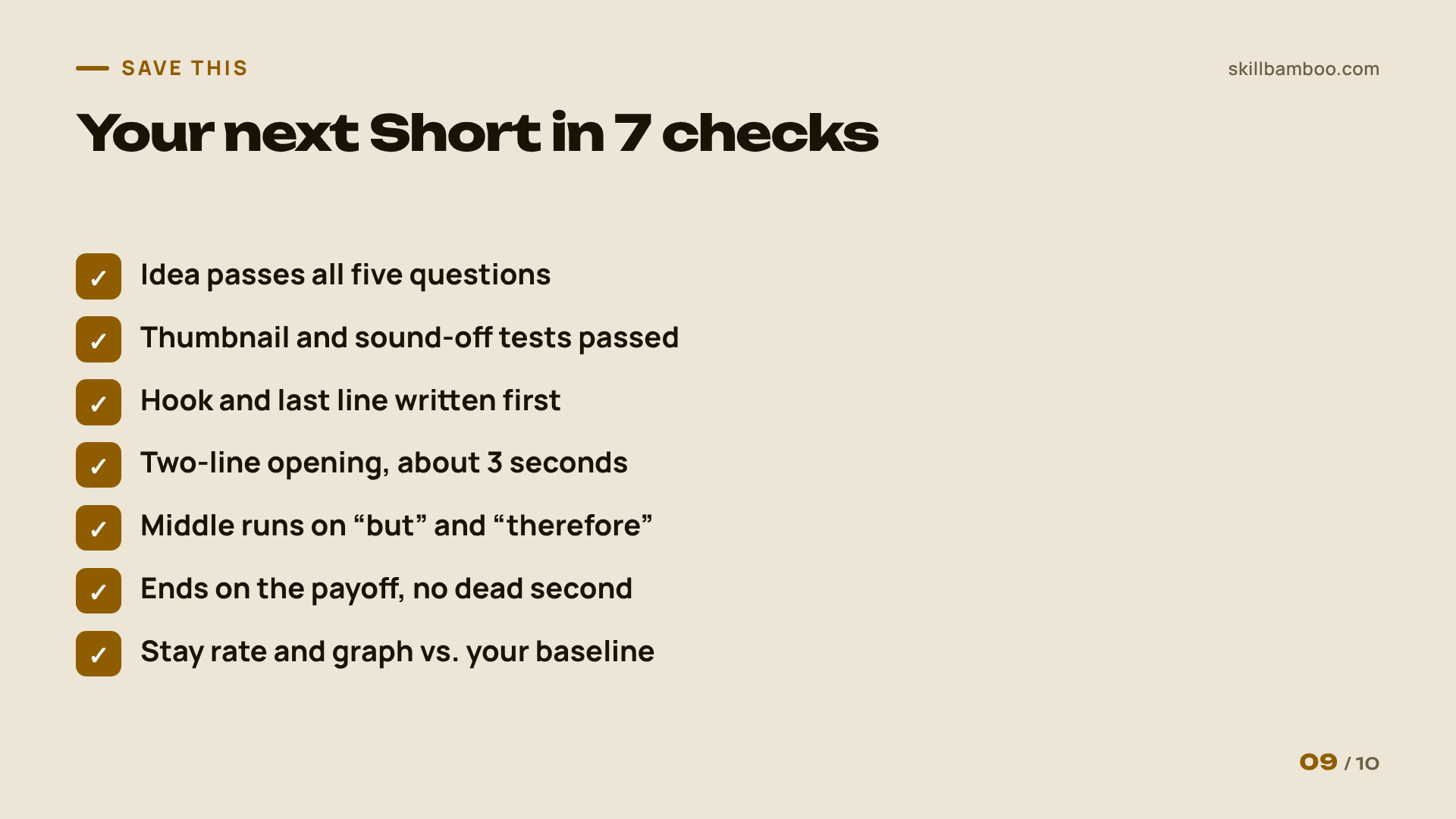
- The idea is one you want to make, it’s doable, and it has a strong hook, a mechanism and rewatch potential
- The first frame passes the thumbnail test and the sound-off test
- The spoken hook is at a fifth-grade reading level or lower
- Hook and last line are written before filming
- The opening is two lines, hook plus foreshadow, in about 3 seconds
- No filler transitions
- The middle runs on “but” and “therefore”
- The ending keeps the promise and adds a twist
- The video ends on the payoff, with no dead last second – check the final second of the retention graph before you call it done
- After posting: stay rate and retention graph checked against your own baseline
Summary
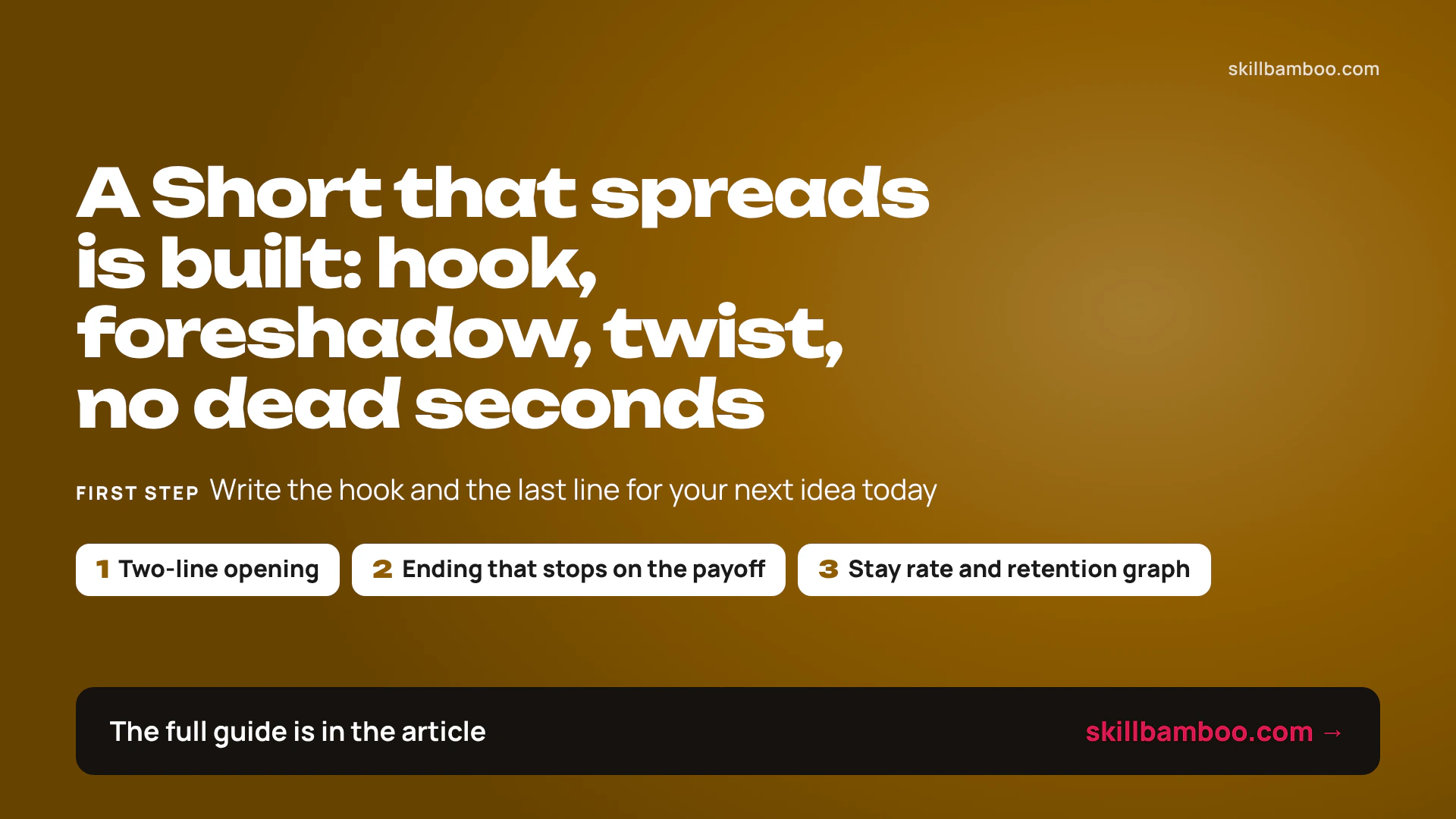
You now have a repeatable skeleton for a Short: a filtered idea, a visual hook, a two-line opening, a moving middle and an ending that stops on the payoff. So write the hook and last line for your next idea today, film to that skeleton, and after publishing read the stay rate and the shape of the retention graph. Treat all benchmarks as rough guides and compare each Short with your own channel’s typical results.
Check yourself
1. Your hook reads: “Today I want to talk about personal finance tips.” What is the best fix?
- A. Make the sentence longer so it explains the topic fully
- B. Show a visual you can understand with the sound off and use plain words a young viewer understands
- C. Add a logo intro so viewers know whose channel it is
Show answer
Answer: B. A hook should work as a thumbnail, be visual and stay at a simple reading level; jargon raises the level.
2. A Short’s retention graph falls sharply in the last second. What should you do?
- A. Cut the ending right after the promised payoff
- B. Add a call to subscribe at the end
- C. Make the Short longer so the drop matters less
Show answer
Answer: A. One dead second at the end can cost several percentage points of retention; trimming it can lift the whole video.
3. Which opening best combines a hook and a foreshadow?
- A. “Hey guys, welcome back to my channel!”
- B. “I’m going to the beach. Let’s get started.”
- C. “I’m going to the beach, and at the end I’ll surprise a stranger with $100.”
Show answer
Answer: C. It states the situation and sets an expectation for the end, giving viewers a reason to stay.
4. Only 85% of viewers chose to watch, but average retention is 95%. What explains it?
- A. It’s a reporting error you should ignore
- B. Viewers are rewatching or looping the Short
- C. YouTube counts swipes as partial views
Show answer
Answer: B. Replays count toward percentage viewed, so it can exceed the share of viewers who stayed – and looping is a strong positive signal.
5. You compare this year’s Shorts views with views from early 2025 and see a big jump. What should you check first?
- A. Whether you are comparing engaged views to old views, since the view definition changed in March 2025
- B. Whether your thumbnail click-through rate went up
- C. Nothing – the jump proves your content improved
Show answer
Answer: A. Since March 31, 2025 any play counts as a view; the old stricter metric is now engaged views.